
My Child Is Bored at School. Can Private Tutoring Actually Challenge Them Further?
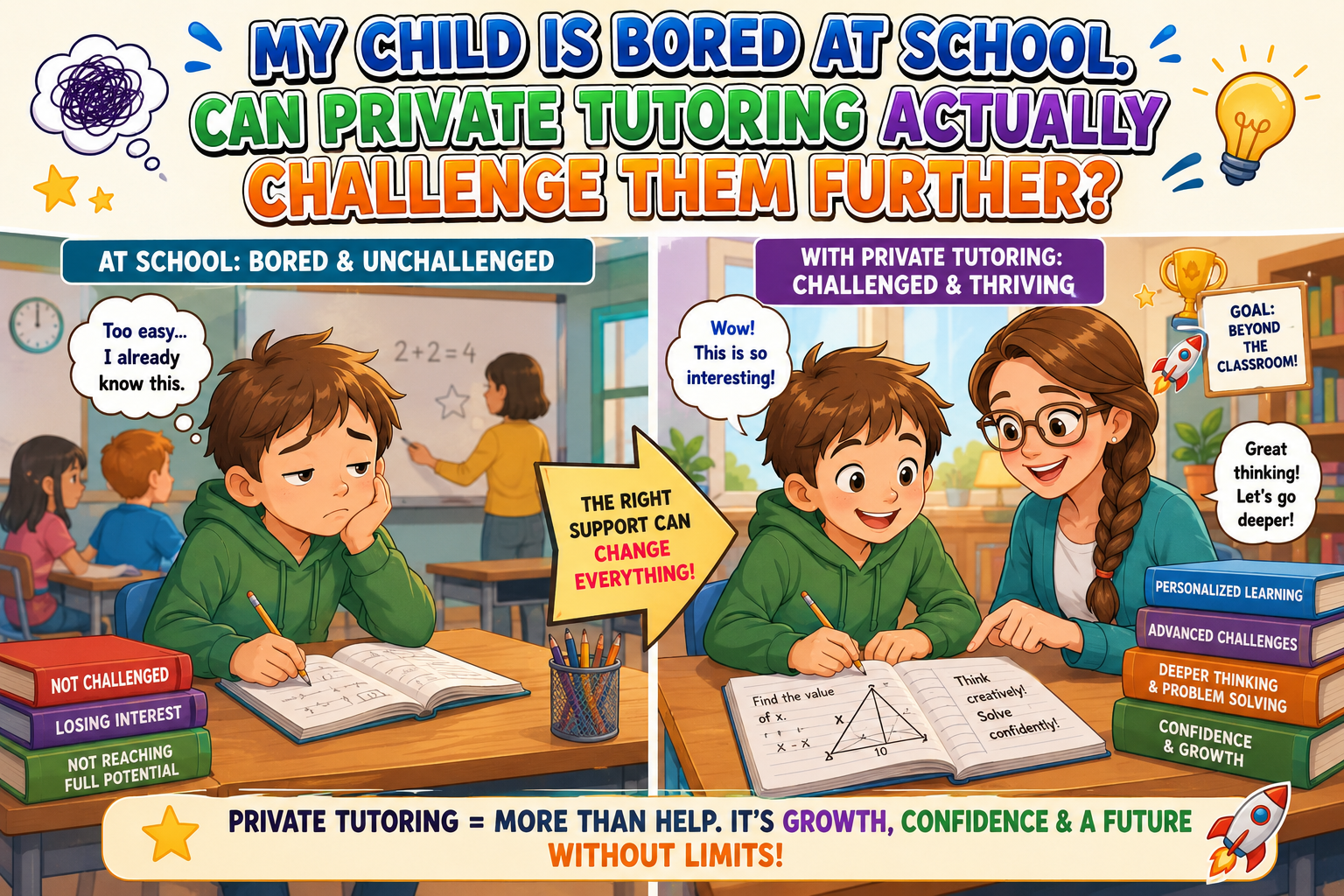
Boredom in a gifted child is not laziness. It is untapped potential with nowhere to go.
In The Queen's Gambit, Beth Harmon does not struggle because chess is too hard. She struggles because the world around her cannot keep pace with how fast her mind moves. She is bored, isolated, and without the kind of challenge that would let her abilities actually develop. The tragedy is not that she lacks talent. It is that her environment has nothing worthy of it.
A child who is bored at school is telling you something important. Not that they are lazy or difficult. Not that they do not care about learning. They are telling you that the environment is not giving their mind anywhere interesting to go. And a mind with nowhere interesting to go will find somewhere to go on its own, which is rarely where you want it.
Private tutoring is not only for students who are struggling. It is one of the most powerful tools available for students who are being underserved by a curriculum that was not designed for the pace at which they learn.
What School Boredom in a Gifted Student Actually Looks Like
Boredom in an advanced student does not always look like disengagement. Sometimes it looks like a student who completes assignments quickly and then causes disruption because they have nothing to do. Sometimes it looks like a student who stops trying entirely because they have learned that the work is always going to be easy, so effort is pointless. Sometimes it looks like a student who develops a sharp and occasionally disruptive sense of humor as the only outlet for a mind that is moving faster than the lesson.
What it almost never looks like is a student who explicitly says I am bored because the work is too easy. Children, particularly older ones, are unlikely to frame it that way. They are more likely to say they hate school, that it is pointless, or that they cannot see the reason for being there.
The diagnostic question worth asking is not whether your child finds school easy. It is whether they ever experience the productive challenge of not immediately knowing the answer. If the answer is rarely or never, boredom is a reasonable response to their environment.
Why Standard Classroom Differentiation Is Not Always Enough
Most schools offer some form of differentiated instruction or enrichment programming. Gifted and talented designations, accelerated tracks, and extension activities. These are genuine efforts to address the needs of advanced learners, and they matter.
But they are also delivered within the constraints of a system that must serve every student simultaneously. A teacher cannot pause the class to run a parallel advanced curriculum for one student. Even the best differentiation in a group setting has practical limits.
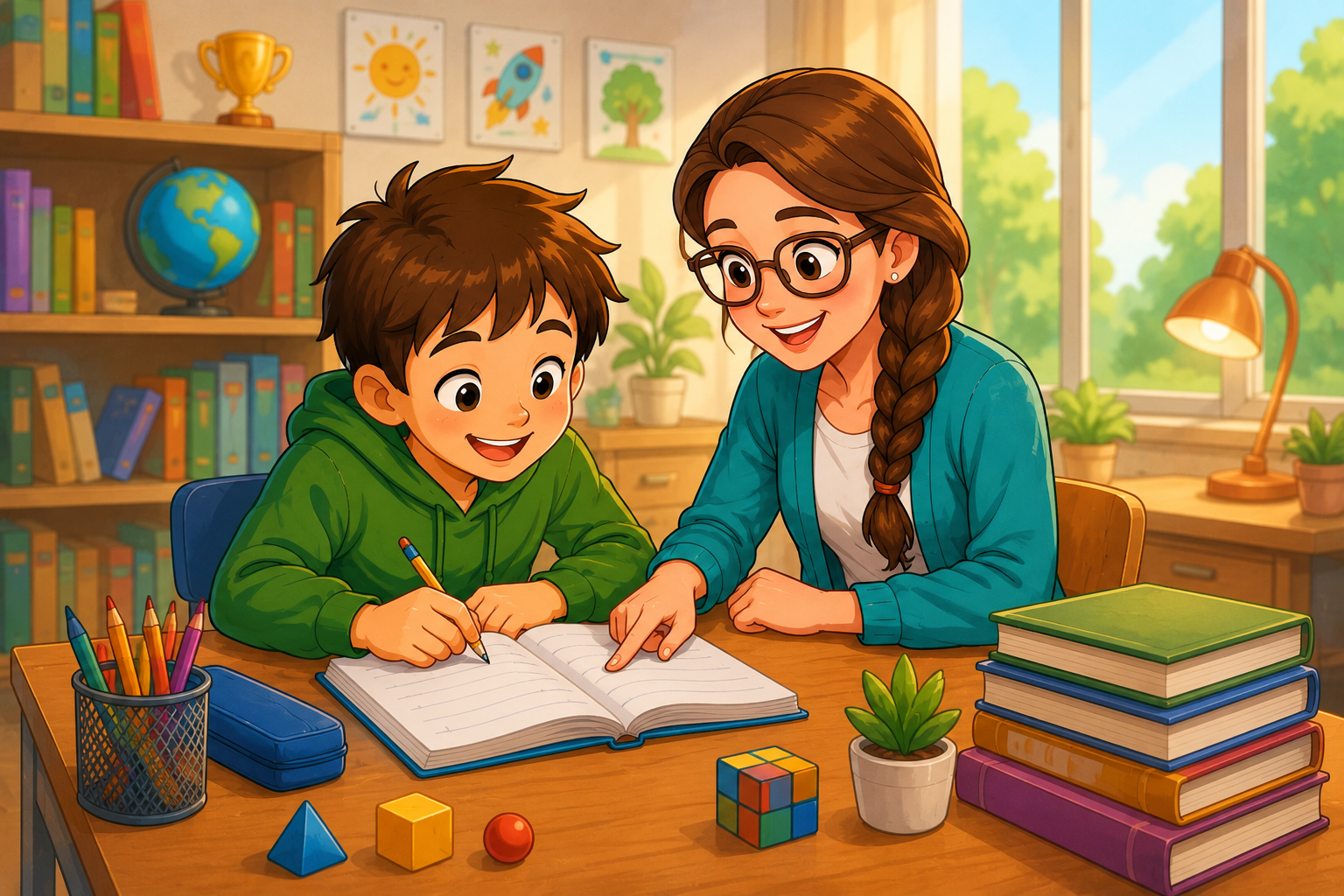
Private tutoring removes those limits. A tutor working one-to-one with an advanced student can move at exactly the pace that the student's mind requires. They can go deeper into topics that capture the student's interest. They can introduce material from the next grade level or beyond without waiting for the class to catch up. They can pursue genuine intellectual challenge rather than additional repetition of already-mastered content.
What Enrichment Tutoring Looks Like at Teachertainment
Jake Perlman's approach to enrichment tutoring is shaped by his B.S. in Theatre with minors in History and Journalism from Northwestern University, his M.Ed. from Pepperdine University, and his years of classroom experience at Canfield Avenue Elementary, Brawerman Elementary, Crete Academy, and St. Timothy School. That combination produces a specific insight: the most powerful enrichment is not more of the same content delivered faster. It is a deeper, more connected, more intellectually alive engagement with ideas.
A student who is bored by their history textbook may come alive when history is connected to journalism, to storytelling, to the question of whose version of events gets told and why. A student who has mastered their grade-level math may find genuine challenge in exploring the mathematical structures underlying music or architecture. A student who devours books may be challenged in a way they have never been by analyzing how a writer constructs meaning rather than just what that meaning is.
This is the teachertainment approach to enrichment: deeper, more connected, more genuinely challenging. Not just harder worksheets. Explore our private K-12 tutoring page to see how we design enrichment sessions around each student's intellectual profile.
The Long-Term Risk of Unaddressed Boredom
This is the honest conversation worth having. Students who are consistently unchallenged in school do not simply coast indefinitely. Over time, the absence of genuine challenge produces a set of habits that become problematic when actual difficulty eventually arrives.
A student who has never had to struggle to understand something has never developed the persistence, the frustration tolerance, or the study skills required to work through genuine difficulty. When that difficulty arrives, often in high school or college, the student may be completely unprepared for it, not because of a lack of ability, but because of a lack of practice with the experience of not immediately knowing the answer.
Enrichment tutoring that provides genuine intellectual challenge serves two functions simultaneously: it meets the student's current need for stimulation, and it builds the resilience and academic habits that will serve them when the work eventually gets hard.
Frequently Asked Questions
How do I know if my child is gifted or just coasting because the work is too easy?
The clearest indicator is how your child responds to a genuine challenge when it is introduced. A student who lights up when given a problem that requires real effort, who engages more deeply when the material is more complex, who asks follow-up questions that go beyond what was assigned, is showing you what their mind is capable of when it is properly engaged. Coasting and giftedness are not mutually exclusive. They often go together.
Is enrichment tutoring different from regular tutoring?
Yes. Regular tutoring typically addresses gaps or reinforces content the student is struggling with. Enrichment tutoring assumes competence and builds from there, going deeper, broader, or further ahead than the current curriculum. The goal is not to help the student keep up. It is to help the student move forward in ways the classroom cannot currently provide.
Will enrichment tutoring make my child even more bored in school?
This is a legitimate concern and worth addressing honestly. For some students, enrichment tutoring that moves significantly ahead of the classroom can widen the gap between what they are doing in sessions and what they are being asked to do in school. The most effective enrichment sessions address this by going deeper into the current curriculum rather than only racing ahead of it, building a richer understanding of what is being taught in school while also extending beyond it.
What subjects can Teachertainment provide enrichment tutoring in?
Teachertainment provides enrichment tutoring across K-12 subjects, including ELA, reading, writing, history, and math. Enrichment sessions can be structured around a student's specific intellectual interests, whether that is deep literary analysis, mathematical exploration, historical research, or creative writing. Reach out to jake@teachertainment.com to discuss what enrichment looks like for your specific child. Our private K-12 tutoring page provides more details.
Can enrichment tutoring help prepare my child for gifted programs or competitive admissions?
Yes. Students who are preparing for gifted program assessments, competitive school admissions, or enriched academic environments benefit significantly from tutoring that develops both the content knowledge and the intellectual habits those programs require. Teachertainment's interview prep service is also relevant for students preparing for school admissions processes that include interviews or portfolio assessments.
My child says school is pointless. Is that boredom or something else?
It can be both. A student who says school is pointless may be bored by the level of challenge and looking for relevance. They may also be dealing with social challenges, disconnection from peers, or something happening outside of school that is affecting how they feel about being there. It is worth having a genuine conversation with your child about what specifically feels pointless. If the answer centers around the work being too easy or too repetitive, enrichment is the right lever. If the answer is more complex, a family consultation may be a useful starting point.
A Bored Mind Is Not a Settled Mind. It Is a Mind Looking for Somewhere to Go

The students who light up the most in Teachertainment sessions are often not the ones who are behind. They are the ones who have been waiting for something genuinely challenging to show up. If your child has been coasting and you want to see what happens when they are actually pushed, email jake@teachertainment.com. Tell us what they are interested in and where the current curriculum is failing to engage them. We will build something worthy of their mind.
