
When most kids walk into a movie theater, they’re probably thinking about three things: the movie, the popcorn, and whether they can convince you that the jumbo-sized slushie is a perfectly reasonable beverage choice.
What they probably aren’t thinking is: Wow, look at all this math!
But it’s everywhere.
How many tickets do we need? What row are we sitting in? How much will our snacks cost? How long until the movie starts? Which concession combo is cheaper? How many seats are left?
A trip to the movies is practically a math lesson with reclining seats.
That’s the idea behind Teachertainment’s Movie Theater Math, a new elementary math packet that turns tickets, showtimes, theater seats, popcorn, concessions, and other familiar parts of going to the movies into meaningful math practice.
The Sum of All Features

A page of numbers can feel abstract. Give a student $10 to spend at a pretend concession stand and suddenly those numbers have stakes.
There is popcorn on the line 🍿.
Movie Theater Math uses the world of the movies to practice early elementary skills including counting, addition, subtraction, comparing numbers, money, time, patterns, graphing, and data.
Instead of simply solving 5 + 2, students might discover whether they can afford popcorn and candy. Instead of reading an isolated clock, they might determine the showtime for the next movie. Instead of interpreting an abstract picture graph, they might analyze votes for popcorn, candy, pretzels, and drinks.
The math hasn’t changed. The reason for doing it has.
Math Goes to the Multiplex
The best part is that the math doesn’t have to stop when the worksheet does.
A real trip to the movies is packed with opportunities to practice the same skills. This does not mean turning family movie night into a two-hour standardized test with popcorn. Pick one or two ideas that fit naturally into the outing.
Coming Soon...But How Soon?
Before leaving home, put your child in charge of the showtime.
If the movie starts at 3:15, ask a younger child to find 3:15 on the schedule or decide whether 2:45 or 4:30 comes first.
For an older child, add another step: “The movie starts at 3:15 and it takes 20 minutes to get there. What time should we leave?”
Or give them three showtimes and a challenge: Which one works if we need to be home by 6:00?
Now telling time has an actual destination.
Row, Row, Row Your Numbers

Hand over the tickets and let your child navigate.
Ask them to find Auditorium 6, Row D, Seats 8–10. Once you’re there, use the seat numbers for a quick pattern challenge: “We have Seats 8, 9, and 10. What comes next?”
If the theater separates odd and even seats, see if your child can figure out the pattern. Or estimate how many seats are in the entire row and then count to check.
For younger children, simply matching the number on the ticket to the number on the seat is useful practice.
And unlike a flash card, Seat 14 has somewhere to be.
Guess Who’s Coming to Concessions?

The concession stand may be the most expensive math manipulative ever invented, so you might as well get some educational value out of it.
Give your child an imaginary $15 budget and have them use the posted prices to build an order without going over.
They could find two items that cost less than $10 together, compare the price of popcorn and candy with nachos and a drink, or see how close they can get to $15 without going over. Older children can estimate the total first, calculate the exact amount, or determine the change from $20.
You do not have to purchase their mathematically perfect order. Consider that an important financial-literacy lesson for the parent.
Honey, I Counted the Previews

Before the trailers begin, everyone predicts how many there will be. Then keep a simple tally.
Prediction: 6
Actual: 8
Difference: 2
Take it one step further by sorting the previews into categories: animated or live action, comedy or adventure, or simply “want to see it” or “definitely not.”
Which category had the most? The fewest? How many more?
You just collected and analyzed data before the feature presentation.
Five Stars and a Few Good Numbers
After the movie, everyone gives it 1–5 stars. With a few family members, you already have a tiny data set.
Find the highest and lowest ratings. Add the stars together. Older children can calculate the average.
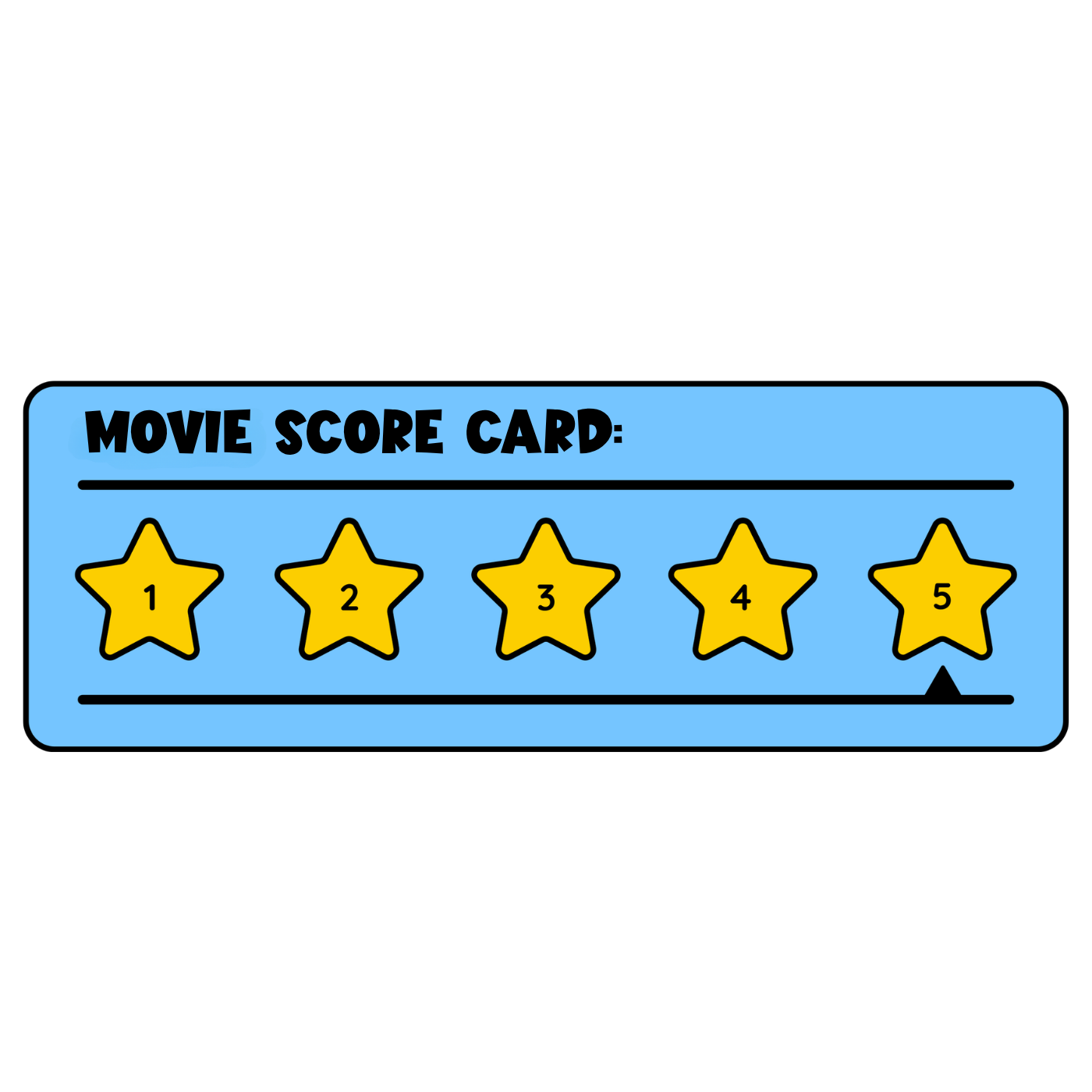
Better yet, keep a Family Movie Scorecard throughout the year. After several movies, your child can rank them, graph the ratings, calculate averages, or determine which star rating your family gives most often.
You’ve accidentally created a longitudinal study of your family’s cinematic opinions. Very prestigious.
And while you’re still at the theater, check the clock. If you sat down at 1:30 and walked out at 3:45, how long were you there? Younger children can simply determine whether you left before or after 4:00, while older students can compare the advertised runtime with the total time spent in the theater.
A Little Math Goes a Long Way

The goal is not to fire math questions at your child from the ticket counter through the closing credits.
One or two quick activities are plenty. Let them find the seats. Give them a concession budget. Make a prediction about the trailers. Check the clock afterward.
Then stop and enjoy the movie.
Real-world practice works because children begin to recognize that the skills they practice in school aren’t confined to school. Numbers are helping them choose a showtime, find a seat, spend money, make predictions, and understand the world around them.
Now Playing in a Classroom Near You

That’s what I wanted to capture with Teachertainment’s Movie Theater Math.
The packet takes the familiar world of tickets, snacks, seats, showtimes, concessions, graphs, and more and uses it to give elementary students purposeful math practice in a context they already understand.
Students still need repetition. They still need to build fluency. They still need opportunities to practice. But when we connect those skills to experiences children already know and enjoy, we can help them see something bigger than the answer to the problem in front of them.
Math isn’t something children only do on a worksheet. It’s something they already do every day. Sometimes, all we have to do is help them notice it.
Teach what they need. Start with what they love.
Education that entertains. Entertainment that educates.
Jake Perlman is the founder of Teachertainment, blending education, entertainment, and pop culture to turn learning into an unforgettable experience.
