
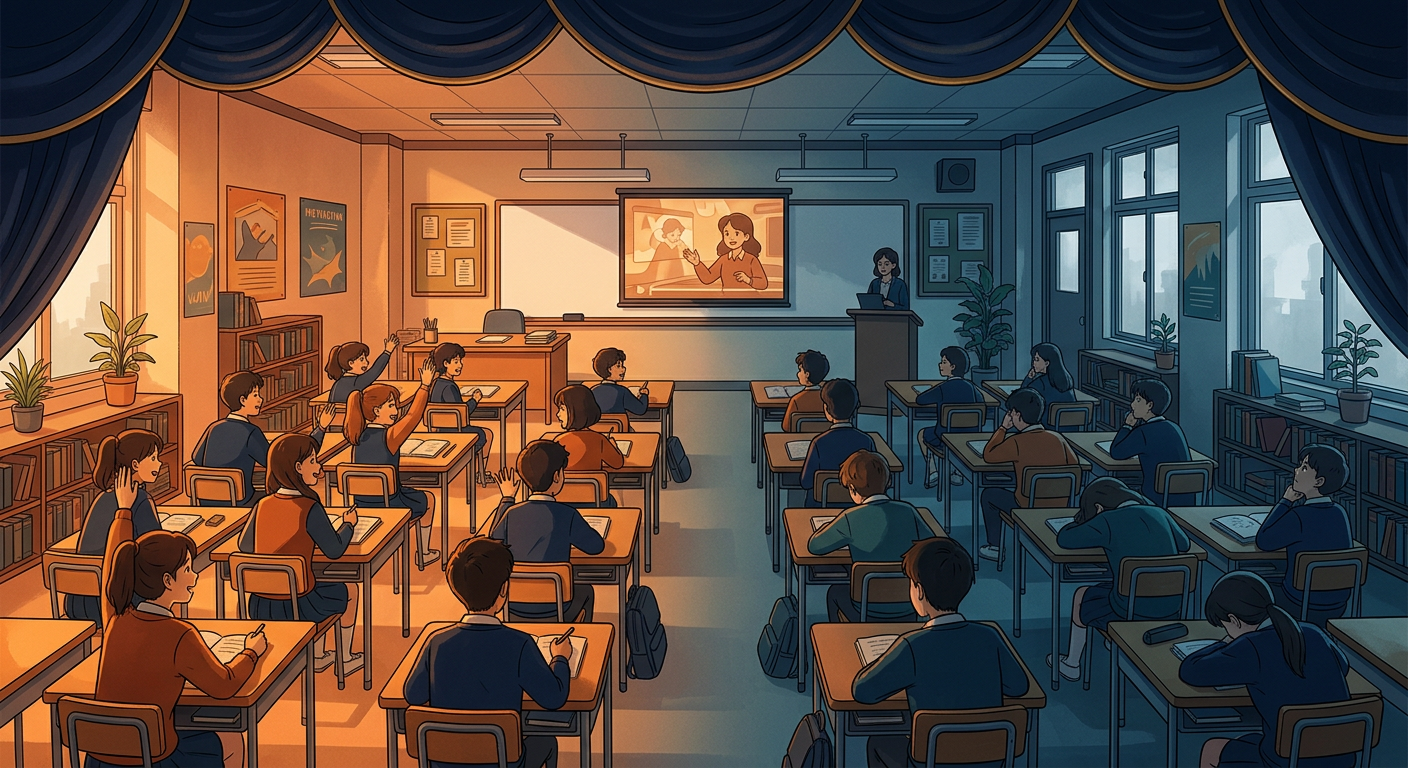
The problem usually is not the material. It is the shape of the fifty minutes around it.
Every play has a second act problem. The opening scene lands, the audience leans in, and then somewhere in the middle, the energy in the room drops. Seasoned directors know this is not a sign the writing failed. It is a sign that the pacing did. The same thing happens in a classroom every single day, and most teachers blame themselves for the wrong reason when it does.
If you are watching eyes glaze over the moment you start explaining something, hands disappearing under desks, the back row going somewhere else entirely, you are not failing at classroom management. You are running into a design problem, not a discipline problem. This post breaks down why the checking out happens, what is actually happening cognitively when it does, and a specific structural fix you can use in your very next lesson.
Why Students Check Out the Moment You Start Talking

Attention is not a character trait. It is a limited cognitive resource that depletes with sustained, passive input. When a teacher talks continuously without a break in the pattern, students shift from active processing into passive listening within a fairly short window, often somewhere between ten and fifteen minutes for older students and considerably less for younger ones.
Once that shift happens, the information you are delivering is landing on a brain that has stopped actively encoding it. The eyes are open. The body is in the seat. But the cognitive work of learning has quietly stopped. This is why a student can appear to be listening for twenty straight minutes and retain almost nothing from it.
Researchers who study classroom talk patterns have found that in the most effective active learning environments, students carry roughly half of the classroom conversation, not the teacher. When the ratio tips too far toward continuous teacher talk, disengagement follows predictably, regardless of how compelling the content actually is.
The Second Act Problem, and How Theatre Solves It

This is where a theatre background turns out to be more useful in a classroom than you might expect. During my time studying theatre at Northwestern University, and later working on Broadway advertising campaigns at Serino Coyne and in theatricals at The Nederlander Organization in New York, I watched the same pattern play out across dozens of productions: a show that holds its audience does not hold them by being continuously loud or continuously quiet. It holds them by changing rhythm.
A scene that runs too long without a shift, a monologue that goes on past its natural point, a stretch of dialogue with no rise and fall, all of it produces the exact same glazed-eye response you see in a classroom. Directors do not fix this by making the content more interesting. They fix it by restructuring the pacing. Shorter beats. A change in tempo. A moment that hands energy back to the audience instead of asking them to keep absorbing.
A classroom works on the same mechanism. The fix for the mid-lesson check-out is almost never more compelling content. It is a change in the shape of the fifty minutes.
A Structural Fix You Can Use Tomorrow: The Ten and Two
Here is a specific structure that applies the same pacing principle directly to lesson design. Break your lesson into ten-minute instructional segments. At the end of each segment, insert two minutes where students are doing something active with what they just heard, not listening to more of it.
The two minutes does not need to be elaborate. It can be a partner turning to explain the concept in their own words. A single sentence written on a whiteboard or scrap paper answering one specific question. A quick show of hands ranking their own confidence on what was just covered. The content of the two minutes matters less than the function it serves, which is handing the cognitive work back to the student before their attention has fully drained.
We have used this structure with students from second grade through eighth grade, and the pattern holds at every level. The lesson content does not need to shrink to fit this rhythm. A fifty-minute lesson comfortably holds three or four of these ten-and-two cycles. What changes is that students are never asked to sit in passive-listening mode for longer than they can actually sustain it.
What to Do When You Cannot Restructure the Whole Lesson
Not every lesson allows for a full redesign, especially mid-unit or mid-semester. When you cannot rebuild the structure from scratch, there is a smaller version of the same fix that works in the moment.
Watch for the Drift, Not the Clock
Rather than watching the clock for a fixed interval, watch the room. The moment you notice the first few students beginning to disengage, that is your cue, not a scheduled break point. Catching the drift early, before it spreads across the room, is far more effective than waiting for a predetermined stopping point.
Use a One-Question Reset
A single well-placed question redirected at the room, not answered by you, can reset attention almost immediately. The question does not need to be complex. It needs to require the room to think rather than continue listening. Even a simple prediction question, what do you think happens next, pulls students back into active processing.
We also want to be honest here: this structure will not solve every engagement problem. A student who is disengaged because of something happening outside the classroom, a difficult morning, an unaddressed learning gap, or ongoing social conflict needs more than a pacing fix. The ten-and-two structure addresses the design problem. It is not a substitute for the relationship-building work that some students need on top of it.
Frequently Asked Questions
Why do students check out even when I am teaching something I find genuinely interesting?
Interest in the content and sustained attention are two different things. A teacher's own enthusiasm for a topic does not change the cognitive reality that passive listening depletes attention after a limited window, typically ten to fifteen minutes for most K-12 students. The fix is structural, not about making the content more compelling. Breaking instruction into shorter segments with active response points in between keeps students cognitively engaged regardless of how interesting the material already is.
How long can students actually sustain focused listening?
This varies by age and by how demanding the content is, but a widely used estimate for sustained passive listening in K-12 settings is roughly ten to fifteen minutes for middle and high school students, and considerably shorter for elementary-age students. This is why the ten-and-two structure caps instructional segments at ten minutes before requiring active response.
What is the difference between disengagement and a discipline problem?
A discipline problem involves a student actively disrupting the learning environment. Disengagement is passive. The student is present and not causing disruption, but is not cognitively processing the material. Treating disengagement as a discipline issue, redirecting attention through correction rather than through a structural change to the lesson, usually does not solve the underlying attention problem and can damage the teacher-student relationship in the process.
Can this structure work for a lesson that requires a lot of direct instruction, like introducing new math concepts?
Yes. Direct instruction segments are exactly where the ten-and-two structure has the most impact, because they are the most passive-listening-heavy parts of a lesson. Breaking new material into shorter instructional chunks, each followed by a brief active response, actually improves retention of technical content because it forces students to process each piece before the next one arrives.
Does Teachertainment offer training on classroom pacing and engagement structures like this one?
Yes. Teachertainment's Teacher Workshops include sessions specifically on lesson pacing, engagement structures, and how principles from live performance translate into classroom design. These sessions are built for teachers who want practical, immediately usable structures rather than general engagement theory.
What if I try this structure and my class still seems checked out?
If a well-paced lesson still is not producing engagement, the cause may be outside the lesson's structure entirely. It is worth considering whether the content itself needs a different entry point, whether specific students are dealing with something unrelated to the lesson, or whether the classroom relationships need more foundational work first. A pacing fix addresses one specific, common cause of disengagement. It is not a universal solution to every form of it.
How is this different from just building in more breaks or brain breaks?
Generic brain breaks, stretching, and a few minutes of free time address physical restlessness but do not necessarily re-engage students cognitively with the content. The two-minute segments in this structure are content-linked. Students are actively working with what was just taught, not simply resting from it. That distinction is what makes the structure effective for retention, not just for managing energy levels.
Your Lesson Plans Deserve Better Pacing Than a Lecture

If pacing and engagement structure are things you want to build into your teaching practice more intentionally, this is exactly the kind of work we do in Teachertainment's Teacher Workshops. Bring us in for a session built around your actual classroom, not generic engagement tips. Email jake@teachertainment.com to talk through what that would look like for your school.
