
My Child Has a Learning Difference. Can a Private Tutor Still Help?

A learning difference is not a learning ceiling. It is a different map to the same destination.
Percy Jackson does not discover that his ADHD and dyslexia are weaknesses. He discovers they are the exact traits that make him exceptional in the world he was actually built for. The story works not because it is fantasy but because it captures something true: what looks like a deficit in one context can be a profound strength in another. A student whose brain processes information differently is not a broken version of a standard student. They are a different kind of learner who needs a different kind of teaching.
Private tutoring for students with learning differences is not a lesser form of support. When done well, it is actually more precisely targeted than anything a general classroom can provide. This post explains what learning-differences-informed tutoring looks like, what it can and cannot do, and how Teachertainment approaches students whose brains work differently.
What We Mean by Learning Differences
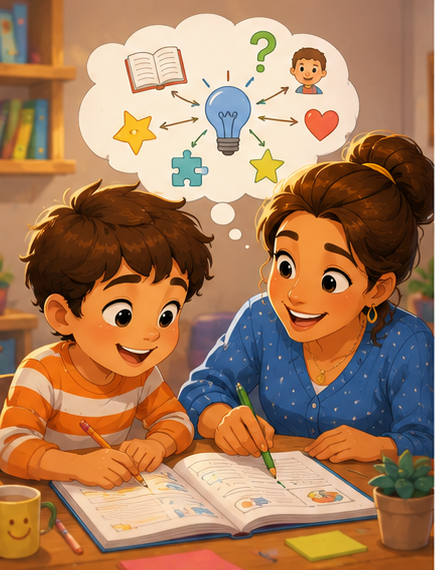
Learning differences are an umbrella term covering a range of neurological variations that affect how students process, retain, and express information. The most commonly encountered conditions in K-12 settings include dyslexia, which affects reading and language processing; dyscalculia, which affects mathematical reasoning and numerical processing; ADHD, which affects attention regulation, impulse control, and executive function; dysgraphia, which affects written expression; and auditory or visual processing differences that affect how students receive and interpret information.
Each of these presents differently in the classroom and requires a different instructional approach. What they share is a mismatch between the student's actual capability and the way that capability is typically assessed and instructed in a standard educational setting.
A student with dyslexia who is brilliant at verbal reasoning may appear to be struggling with reading comprehension when they are actually struggling with the decoding process. A student with ADHD whose ideas are genuinely sophisticated may appear to be disorganized or lazy when they are actually dealing with an executive function challenge that makes translating ideas into structured written work genuinely difficult.
What Private Tutoring Can Do for a Student With a Learning Difference

Individualized Pacing and Approach
The single greatest advantage of private tutoring for students with learning differences is the ability to adjust pace, format, and delivery in real time based on how a specific student processes information. A classroom teacher managing twenty-five students cannot slow down for one student's processing speed or switch modalities because one student responds better to auditory explanation than visual instruction. A private tutor can do both simultaneously.
Strength-Based Entry Points
Jake Perlman's approach at Teachertainment, developed across years of teaching at Canfield Avenue Elementary, Brawerman Elementary, Crete Academy, and St. Timothy School, and informed by his M.Ed. from Pepperdine University, consistently starts with what the student is good at rather than what they struggle with. This is particularly powerful for students with learning differences, who often arrive at sessions having already internalized a story about themselves as limited or incapable. Starting from strength resets that story before the academic work begins.
Multisensory Instruction
Many students with learning differences benefit significantly from multisensory instruction that engages multiple processing pathways simultaneously. Verbal explanation paired with visual representation paired with physical engagement produces more durable learning for many students than any single modality alone. Private tutoring provides the flexibility to integrate these approaches in ways that classroom instruction typically cannot.
The Teachertainment Advantage
The pop culture and entertainment-based entry points that define Teachertainment's approach are particularly effective for students with learning differences because they activate existing knowledge and enthusiasm before introducing academic content. A student with ADHD who cannot sustain attention during a traditional reading lesson may be fully engaged for extended periods when the same reading skills are applied to content they genuinely care about. Our private K-12 tutoring page explains how this works across different subject areas.
What Private Tutoring Cannot Do?
We want to be honest about the limits of what private tutoring provides for students with learning differences.
Private tutoring is not a substitute for a formal evaluation. If you suspect your child has a learning difference that has not been formally identified, the right first step is an evaluation by a qualified specialist, typically an educational psychologist or neuropsychologist. A formal diagnosis opens access to accommodations, support services, and resources that tutoring alone cannot provide.
Private tutoring also cannot replicate specialized intervention programs designed specifically for certain learning differences. A student with significant dyslexia, for example, benefits most from a structured literacy program delivered by a trained specialist. General tutoring, even very good general tutoring, is not a substitute for that specialized intervention.
What tutoring can do is complement both formal evaluation and specialized intervention by providing individualized academic support that addresses the student's current curriculum within a framework that accounts for how they learn best.
How to Talk to a Tutor About Your Child's Learning Difference
Be specific and be upfront. Tell the tutor exactly what the learning difference is, what formal supports or accommodations your child currently receives at school, which strategies have worked in the past, and which have not. A tutor who cannot incorporate this information into their approach is not the right tutor for your child.
Also, share what your child is good at. The strengths matter as much as the challenges for building a tutoring approach that will actually work. A tutor who enters the first session already knowing that this student is brilliant at verbal reasoning but struggles with written expression can design a much more effective session than one who discovers this mid-session.
Frequently Asked Questions
Does my child need a formal diagnosis to benefit from tutoring designed for learning differences?
No. A formal diagnosis provides important information and opens access to school-based accommodations, but a good tutor can adapt their approach based on what they observe in sessions, even without a formal label. If you suspect a learning difference but have not pursued evaluation, share your observations with the tutor and let them adjust their approach based on what they see.
Can tutoring help my child with ADHD focus during sessions?
Yes, with the right session design. Shorter activity segments with built-in variety, movement breaks, clear and immediate feedback, and high-interest content all support sustained attention for students with ADHD. A tutor who designs sessions with ADHD in mind is working with the student's neurological profile rather than against it. This is significantly more effective than asking the student to focus through traditional extended instruction.
What is the difference between a learning specialist and a private tutor?
A learning specialist typically holds specific credentials in assessing and addressing particular learning differences, such as a trained reading specialist for dyslexia intervention. A private tutor provides individualized academic support that can be adapted to accommodate a learning difference, but is not typically trained as a specialist. For students with significant identified learning differences, the most effective support often combines specialist intervention with general academic tutoring.
Can Teachertainment work alongside my child's IEP or 504 plan?
Yes. Teachertainment sessions can be designed to complement and reinforce the supports outlined in a student's IEP or 504 plan. Sharing the relevant accommodations and goals with Jake before sessions begin allows us to design tutoring that works in the same direction as the school-based support rather than independently of it. Reach out at jake@teachertainment.com to discuss how we approach this.
My child has a learning difference and has had bad tutoring experiences before. What makes Teachertainment different?
Most bad tutoring experiences for students with learning differences happen when the tutor uses the same instructional approach that has not been working in the classroom. Teachertainment starts with what the student cares about and what they are good at before introducing academic content. That shift in entry point often produces a completely different experience for students who have struggled in traditional settings. Our private K-12 tutoring page explains more about how we approach first sessions.
How do I know if the tutoring is working for my child with a learning difference?
Look for behavioral indicators before academic ones. Willingness to engage with the subject, reduced avoidance behavior, increased confidence in attempting challenging tasks, and the ability to articulate their thinking more clearly are all indicators that the tutoring approach is working. Academic improvement typically follows these behavioral shifts by several weeks.
Different Map. Same Destination. Let Us Help Your Child Find Their Route

A learning difference is not a barrier to academic achievement. It is a signal that the standard instructional approach needs to be adapted to fit how this particular student actually learns. If your child has a learning difference and you are looking for tutoring that starts from their strengths rather than their struggles, email jake@teachertainment.com before you book. Tell us about your child's learning profile and what has and has not worked before. We will build something that fits.
