
Why Is My Child Failing Math and What Can a Private Tutor Do About It?
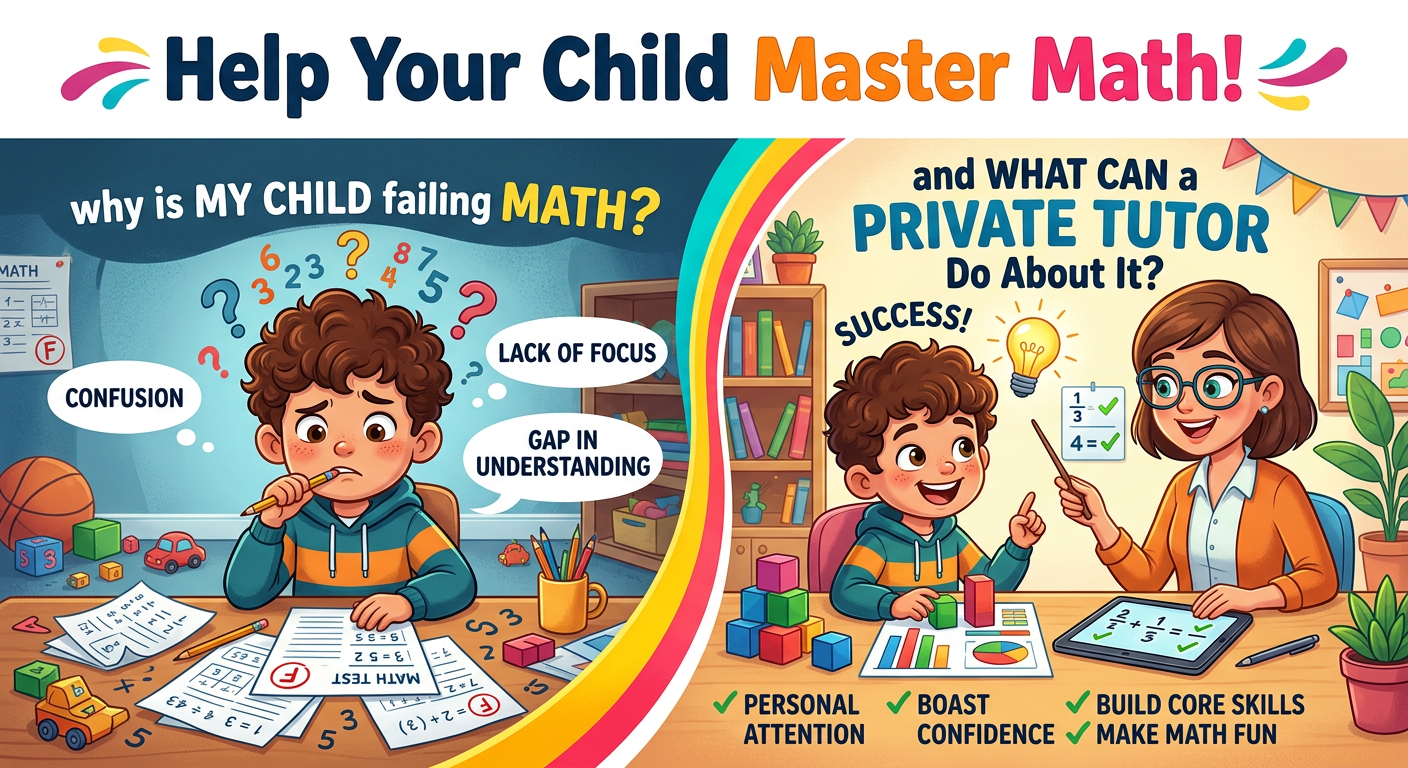
The answer is rarely laziness. It is almost always a gap nobody caught early enough.
On Extreme Makeover: Home Edition, the team never had unlimited resources. They had a timeline, a budget, and a commitment to doing something meaningful within those constraints. What made the results remarkable was not the money. It was the clarity of purpose and the creativity of execution. Families looking for affordable private tutoring are working with the same dynamic. The question is not whether quality support is possible on a budget. It is about finding the approach that delivers real value within what you can actually spend.
At Teachertainment, we believe every family deserves access to tutoring that actually works. This post is our honest guide to understanding what affordable tutoring looks like, what to prioritize when budget is a factor, and how to make every tutoring dollar count.
The Real Reasons Children Fail Math

A Foundational Gap Nobody Caught
Math is a sequential subject. Each concept builds directly on what came before. A student who did not fully grasp fractions will struggle with decimals. A student who never solidified decimals will struggle with percentages. A student shaky on percentages will hit a wall in algebra. By the time the grade is failing, the gap is often two or three years back, not in the current unit at all.
This is the most common cause of math failure we encounter, and it is also the most consistently missed by classroom instruction because a teacher managing twenty-five students cannot always identify exactly where the foundational break occurred for each individual child.
Math Anxiety That Has Become Self-Reinforcing
Math anxiety is a documented psychological phenomenon that affects a significant percentage of students. It is not a personality trait. It is a learned response, typically triggered by early experiences of public failure, comparison, or timed testing pressure. Once established, math anxiety creates a feedback loop: anxiety impairs performance, poor performance confirms the belief that math is impossible, and that belief deepens the anxiety.
A student in this loop is not failing math because of limited ability. They are failing math because their nervous system has associated mathematical thinking with threat. Breaking that loop requires more than additional practice. It requires a fundamentally different emotional relationship with the subject.
Instruction That Does Not Match How the Student Learns
Every student processes information differently. Some need visual representations. Some need a real-world application before abstract notation makes sense. Some need to move, to talk through problems, to build physical models before the concept clicks. Classroom instruction, by necessity, delivers math in a standardized format. For students whose processing style does not align with that format, the content never fully lands, no matter how many times it is repeated.
Disengagement From the Subject
A student who has decided that math is not for them is a student who has stopped paying attention during instruction, stopped attempting homework with genuine effort, and stopped asking for help when they get stuck. Disengagement looks like an ability on the surface. It is not. It is a protective response to repeated experiences of failure or irrelevance.
What a Private Tutor Can Actually Do, That a Classroom Cannot

Private tutoring addresses math failure differently from classroom instruction because it operates at a resolution that group teaching cannot match. A tutor works with one student. That means every session can begin exactly where that student is, not where the curriculum says they should be.
Jake Perlman's approach at Teachertainment draws on his M.Ed. from Pepperdine University and his years of classroom teaching to build math tutoring sessions that start with the student's specific gap rather than the current chapter. Before we address the unit your child is failing, we identify where the foundational break occurred. Then we build from there, reinforcing the missing concepts while simultaneously connecting to the current material, so your child does not fall further behind while we catch them up.
We also approach math through the teachertainment lens. A student who has decided math is not for them responds differently when the math is embedded in something they actually care about. Game scoring systems. Sports statistics. Music production. Video game design. The math does not change. The entry point does. And that entry point is often the difference between a student who shuts down and one who leans in.
How to Know If Your Child Needs a Math Tutor

Not every child who struggles with a math unit needs a tutor. But there are specific signals that suggest the struggle has moved beyond what additional classroom support or homework review can address.
Your child consistently scores significantly below the class average on math assessments, not just occasionally. Your child expresses strong negative emotions about math that go beyond normal frustration. Your child cannot explain their thinking on problems, even when they arrive at the correct answer. Your child has begun avoiding math homework entirely, rather than attempting and getting stuck.
Any one of these signals is worth taking seriously. All four together are a clear indication that targeted support is needed before the gap compounds further.
We also want to be honest: some students who are failing math are dealing with an unidentified learning difference that affects how they process numerical information. If standard tutoring approaches are not producing results after a consistent effort, it may be worth consulting with a specialist to rule out dyscalculia or other processing differences.
Frequently Asked Questions
Why is my child failing math if they seemed to understand it last year?
Math builds cumulatively. A concept that seemed solid last year may have had a gap that only becomes visible when the next level of complexity is introduced. This is one of the most common patterns we see: a student who appeared to be keeping up suddenly hits a wall when a new unit requires a skill that was never fully consolidated. The fix is identifying exactly where the break occurred and reinforcing it before continuing forward.
How does a private tutor identify where a student's math gap actually is?
A good math tutor does not start with the current failing unit. They work backward through prerequisite concepts to find the point where the student's understanding breaks down. This diagnostic process usually takes one to two sessions and produces a clear picture of where to focus. Everything that follows is built on that foundation rather than on the assumption that the current chapter is the problem.
Can tutoring help a student who says they hate math?
Yes, and this is where the Teachertainment approach is particularly effective. A student who hates math has almost always had experiences that made them feel incapable or excluded from mathematical thinking. Reintroducing math through something the student genuinely cares about, sports data, game design, music, changes the emotional context enough to make engagement possible again. Our private K-12 tutoring sessions are designed with this in mind.
How quickly can tutoring improve my child's math grades?
This depends significantly on how deep the foundational gap is and how consistent the sessions are. A student with a gap of one grade level typically shows measurable improvement within four to six weeks of consistent tutoring. A student with a deeper multi-year gap may take a full semester to fully close it while simultaneously maintaining pace with the current curriculum. Honest progress tracking throughout the process is essential.
What is the difference between math tutoring and math homework help?
Homework help addresses today's assignment. Math tutoring addresses the underlying skill gaps that are making today's assignments difficult. A tutor who only helps a student complete their homework is not closing the gap. They are helping the student get through the night. Real tutoring works on the foundations so that future assignments become manageable independently.
Should I get my child tested before starting math tutoring?
A formal assessment is not required before starting tutoring. A skilled tutor will conduct their own diagnostic in the first one to two sessions to identify where the gap is. However, if you suspect your child may have a learning difference that is affecting their math processing, a formal evaluation by a specialist can provide valuable information that shapes the tutoring approach. Teachertainment's family consultation can help you decide whether a formal assessment makes sense before you begin.
Math Is a Superpower. It Just Needs the Right Unlock

Katherine Johnson did not need someone to tell her she was brilliant. She needed someone to get out of her way and give her the right environment to work in. Your child needs the same thing: a tutor who starts where they actually are, not where the curriculum says they should be. Email jake@teachertainment.com and tell us which grade level and which concepts have your child stuck right now. We will map the gap and build the path forward.
